
Providing excellent patient care doesn’t always guarantee reimbursement. For orthotics and prosthetics (O&P) practices, even clinically appropriate treatment can result in a denied claim when the supporting documentation doesn’t meet payer requirements. That’s why medical necessity documentation is such an important part of a healthy revenue cycle.
The challenge is rarely that practitioners are providing the wrong treatment or failing to document patient encounters outright. Typically, the problem is that the clinical records don’t clearly demonstrate why a particular device or treatment was necessary.
As Erin Cammarata, founder and president of CBS Medical Billing & Consulting, explained in her article for The O&P EDGE, The Documentation Disconnect:
“Doing the right thing and documenting the right thing are not the same, and that gap is where many denials live.”
Let’s explore what strong medical necessity documentation looks like, why documentation-related denials occur, and how O&P practices can improve their processes to protect reimbursement.
What Is Medical Necessity Documentation?
Medical necessity documentation is the clinical evidence used to demonstrate that a particular treatment, service, or medical device is appropriate and necessary for a patient’s condition.
For O&P practices, this means documenting more than a diagnosis or the delivery of an orthotic or prosthetic device.
The patient’s medical record should clearly establish:
- The patient’s condition: What diagnosis or clinical findings support the need for treatment?
- Functional limitations: How does the condition affect the patient’s mobility, independence, or daily activities?
- The need for the specific device: Why is this particular orthosis or prosthesis appropriate?
- Expected patient benefit: How will the patient use and benefit from the prescribed device?
These questions are central to medical necessity documentation because they help establish the connection between the patient’s clinical condition and the treatment being provided. Importantly, the exact evidence required varies by device, payer, and applicable coverage policy.
Documentation is the language of payment.
In other words, a practitioner may understand perfectly well why a patient needs a device, but the payer must be able to reach that same conclusion from the medical record.
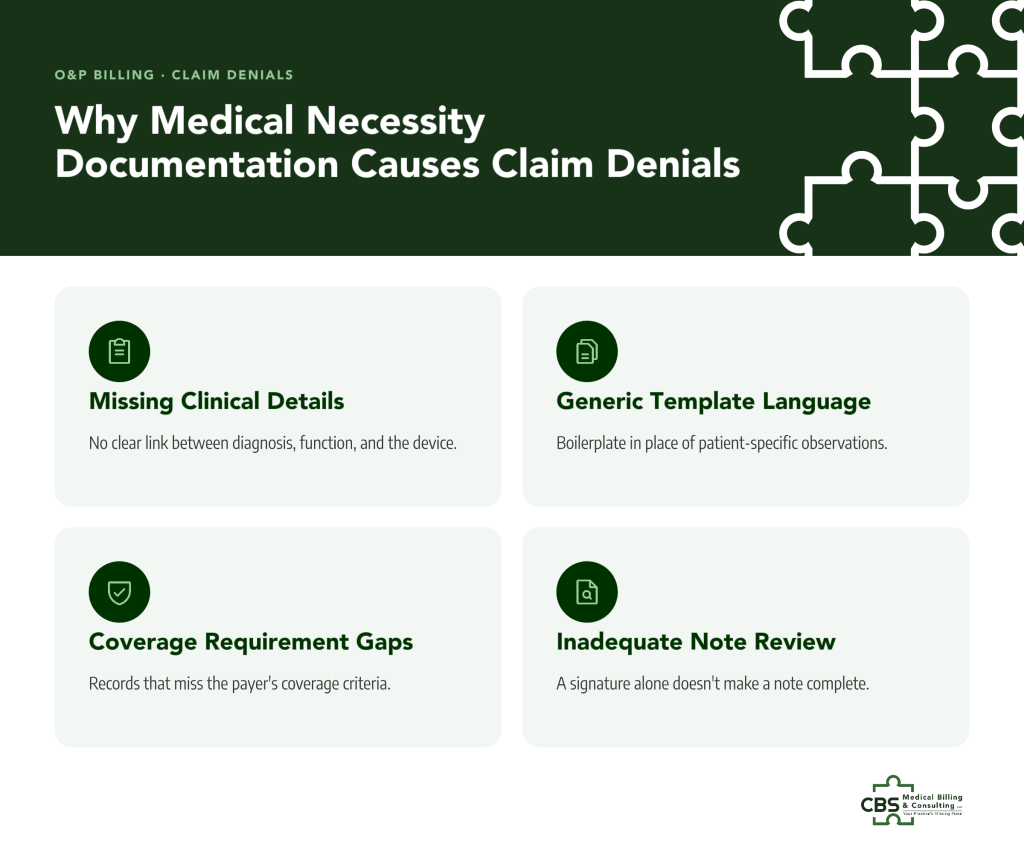
Why Medical Necessity Documentation Causes Claim Denials
One of the most frustrating experiences in O&P billing is receiving a denial for a device that was clinically appropriate and successfully delivered. Unfortunately, medical necessity documentation can fall short even when the underlying patient care was excellent.
Common problems include:
1. Missing Clinical Details
A record might identify the patient’s diagnosis without explaining how the condition affects function or why a particular device is necessary. For example, documenting that a patient has difficulty walking may not provide enough information to establish the specific clinical need for an orthosis. The record should communicate the individual patient’s limitations, relevant examination findings, and clinical reasoning.
2. Generic or Incomplete Template Language
Documentation templates can save considerable time, but they also create opportunities for errors. In her 2024 article, Documenting Patient Encounters, Erin describes reviewing records containing generic statements such as:
“Patient was able to ambulate without concerns.”
Although a statement like this may address a basic documentation field, it doesn’t necessarily communicate the practitioner’s expertise or the patient’s individual circumstances.
Templates should guide documentation, not replace patient-specific clinical observations.
3. Documentation That Doesn’t Match Coverage Requirements
Different devices and services have different coverage criteria. If the medical record fails to address an applicable requirement, the claim may be denied even when the treatment was appropriate.
This is why effective medical necessity documentation requires practitioners to understand the relevant payer policies before the claim is submitted.
4. Inadequate Review of Clinical Notes
Documentation created by assistants, residents, or automated systems must be carefully reviewed.
Erin emphasizes that the treating practitioner is responsible for ensuring the approved note accurately reflects the encounter and supports applicable coverage and coding requirements. A signature alone doesn’t guarantee that the documentation is complete.
A Real Example: Medicare’s Knee Orthosis Coverage Changes
The Documentation Disconnect, provides a particularly useful example of how medical necessity documentation affects reimbursement.
Changes to Medicare’s knee orthosis coverage criteria expanded access to certain osteoarthritis braces by removing the previous requirement for documented joint instability in applicable circumstances.
This created new opportunities for patients who could benefit from these devices. However, expanded coverage didn’t eliminate the need for thorough documentation.
As Erin explained, the revised criteria place importance on evidence such as:
- Osteoarthritis supported by imaging
- Functional limitations
- Pain affecting mobility
- Detailed physical examination findings
- The patient’s ability and willingness to use the prescribed brace
The lesson is straightforward: When coverage requirements change, documentation practices must change with them.
A practice might be treating the same patient population with the same clinical expertise, but the information necessary to support reimbursement can evolve. This is a strong example of why medical necessity documentation should be reviewed regularly rather than treated as a fixed administrative process.
For current Medicare requirements, practitioners should review the applicable knee orthosis policy article and related coverage determination.
Staying current with Medicare policy changes through CMS.gov is essential to successful medical billing. But keeping up with evolving coverage requirements takes time and expertise. At CBS, monitoring these changes and helping O&P practices adapt their billing processes is part of what we do, so you can spend less time navigating Medicare requirements and more time caring for patients.
How to Improve Medical Necessity Documentation at Your O&P Practice
Improving documentation doesn’t necessarily mean writing longer notes or adding more administrative work.
The goal is to make clinical records more complete, specific, and consistent with applicable payer requirements.
Here are five practical improvements O&P practices can implement.
1. Understand the Applicable Coverage Requirements
Start with the requirements for the devices and services your practice provides.
Review relevant Medicare Local Coverage Determinations (LCDs), Policy Articles, and commercial payer policies.
Identify the documentation requirements that apply to each type of device.
Rather than assuming a reviewer will understand the clinical reasoning, make sure the medical record directly addresses each applicable criterion.
Erin shares an interesting analogy in The Documentation Disconnect. When applying for approval to build a pool through her community’s architectural review board, she carefully studied the requirements, responded to each one, and organized the supporting information into easy-to-review exhibits.
Her application was approved without additional back-and-forth.
She applied the same principle she has used throughout her career working with Medicare: Understand the requirements and make it easy for the reviewer to say yes.
2. Use Documentation Templates Without Losing Individuality
Well-designed templates can make medical necessity documentation more efficient. They help practitioners remember required information and create consistency across patient encounters. However, templates should never substitute for individualized clinical observations.
When using templates:
- Customize findings to reflect the individual patient.
- Remove irrelevant or contradictory statements.
- Check for incorrect pronouns and other leftover template language.
- Ensure the note communicates the practitioner’s clinical reasoning.
- Confirm that the information supports the specific device being provided.
A strong template should help practitioners document their expertise, not reduce clinical encounters to a collection of generic statements.
3. Establish Clear Documentation Review Procedures
Whether notes are written by practitioners, assistants, or residents, a consistent review process is essential.
Before approving a record, the treating practitioner should verify that the documentation accurately describes the patient encounter, includes necessary clinical findings, and supports applicable medical necessity and coding requirements.
This is particularly important when other team members assist with documentation. Erin cautions against signing notes that haven’t been carefully reviewed. The practitioner approving the record remains responsible for its accuracy and completeness.
4. Use AI Carefully and Maintain Clinical Oversight
Artificial intelligence is becoming increasingly useful for clinical documentation.
AI-powered tools can assist with transcription, organizing notes, and identifying possible omissions. However, they also introduce important considerations.
As Erin explains in Documenting Patient Encounters, AI cannot replace the professional expertise and critical thinking of an orthotist or prosthetist.
AI-generated documentation must be reviewed for clinical accuracy, patient-specific detail, and consistency with coverage requirements. Practices must also evaluate the privacy and security of any AI platform before entering protected health information, including its HIPAA safeguards and whether appropriate contractual protections are in place.
Technology can make medical necessity documentation more efficient, but the treating professional must remain accountable for the final clinical record.
5. Review Documentation Before Claim Submission
One of the most effective ways to prevent documentation-related denials is to identify deficiencies before submitting a claim.
Establish a review process that checks whether the necessary clinical evidence is present and consistent with the applicable coverage criteria. This may involve coordination between practitioners, administrative staff, and billing specialists.
When a documentation deficiency is identified, it should be addressed through appropriate, compliant documentation procedures rather than simply submitting the claim and hoping it will be approved.
The objective is to prevent avoidable denials before they enter the revenue cycle.
How Better Documentation Improves Revenue Cycle Management
Medical necessity documentation isn’t just a clinical or compliance concern. It’s an essential part of revenue cycle management.
When documentation is incomplete, the financial consequences can extend beyond a single denied claim.
Staff may spend additional time investigating denials, gathering records, communicating with payers, and preparing appeals.
Reimbursement can be delayed, increasing outstanding accounts receivable and creating additional administrative work.
Conversely, stronger documentation processes can help O&P practices:
- Prevent avoidable medical necessity denials.
- Reduce time spent correcting and appealing claims.
- Support more consistent reimbursement.
- Improve audit readiness.
- Strengthen communication between clinical and billing teams.
- Protect the practice’s cash flow.
These improvements reinforce an important principle of how to improve revenue cycle management: many billing problems originate long before a claim reaches the payer.
By improving documentation upstream, practices can address the underlying causes of denials rather than repeatedly correcting the same problems.
Conclusion: Strong Medical Necessity Documentation Starts With Strong Clinical Communication
The purpose of medical necessity documentation isn’t simply to satisfy an insurance company’s checklist. It’s to communicate the practitioner’s expertise, demonstrate why treatment is necessary, and create a clear record of the care provided.
Erin’s message across her articles is consistent: Good clinical care must be supported by documentation that tells the complete story.
That means understanding coverage requirements, documenting individual patient needs, using technology responsibly, and reviewing records before claims are submitted.
For O&P practices, improving medical necessity documentation can mean fewer preventable denials, stronger compliance, and a healthier revenue cycle.
CBS Medical Billing & Consulting specializes in helping O&P practices navigate the complex relationship between clinical documentation, payer requirements, and reimbursement.
If your practice is experiencing recurring medical necessity denials, documentation-related billing problems, or inconsistent reimbursement, our team can help identify opportunities to strengthen your billing processes.
Contact CBS Medical Billing & Consulting to schedule a consultation.