

How to Improve Revenue Cycle Management at Your O&P Practice
If you are asking how to improve revenue cycle management at your O&P practice, simply getting better at submitting claims isn’t enough. Revenue cycle management is an ongoing process. You must continually monitor, tweak, and refine.
Patient intake, insurance verification, prior authorization, documentation, coding, claim submission, payment posting, denial management, and accounts receivable all play a role in whether your practice gets paid and how quickly.
A problem anywhere in that process can eventually become a revenue problem. That’s why improving revenue cycle management requires looking at the entire system, identifying where problems originate, implementing corrective action, and then measuring whether your changes actually worked.
Erin, the founder and president of CBS, calls this “putting the management into revenue cycle management.”
Revenue Cycle Management Problems Often Start Upstream
A denied claim might look like a billing problem. But actually the mistake may have happened weeks earlier, way upstream in the RCM process.
The patient’s eligibility wasn’t properly verified. Prior authorization wasn’t obtained. Required documentation was missing. The documentation didn’t support the code. A modifier was incorrect. The claim sat too long before submission. All of these could cause a denied claim.
This is especially important in O&P, where reimbursement often depends on highly specific documentation, coding, medical necessity, and payer requirements.
In 2026, for example, Medicare expanded its prior authorization requirements for DMEPOS, adding seven HCPCS codes to the existing list of 67. Five of those seven additions were L-codes.
If your practice doesn’t identify that requirement until after the device has been provided, the billing team inherits a problem it may not be able to fix. That’s why, when considering how to improve revenue cycle management, one of the most effective places to start is upstream.
Don’t just ask:
How do we fix this claim?
Ask:
What allowed this RCM problem to happen in the first place?
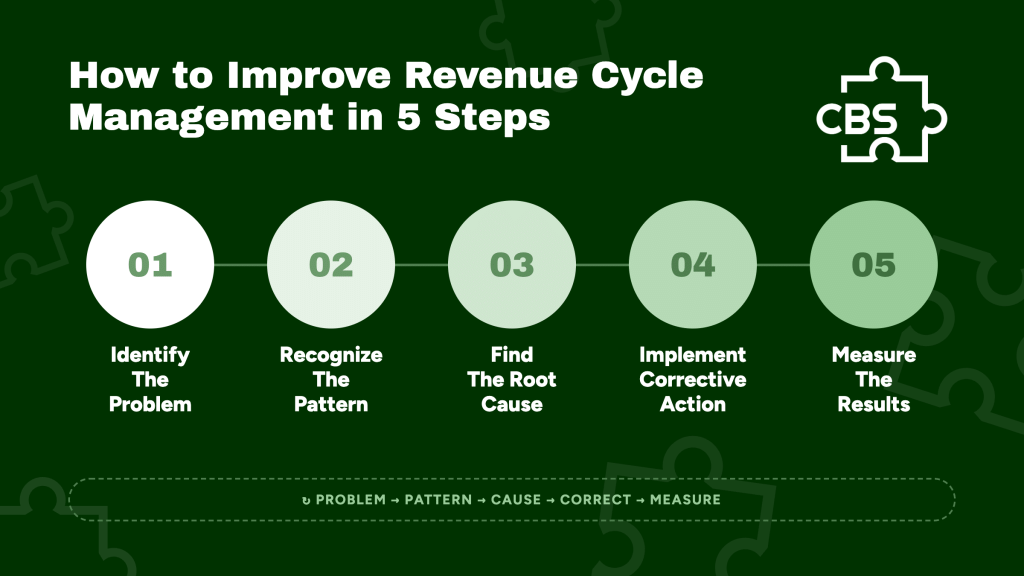
How to Improve Revenue Cycle Management in 5 Steps
Root cause analysis is one of the most useful tools for improving revenue cycle management. Rather than repeatedly treating individual symptoms, root cause analysis helps you identify the process producing the underlying issue.
Here are five steps your O&P practice can use:
1. Identify The Problem
Start with the symptoms of RCM problems. Common warning signs include:
- A decrease in your clean claim rate
- An increase in claim denials
- Slower reimbursement
- Reduced or inconsistent cash flow
- Increasing accounts receivable
- A growing percentage of A/R over 90 days
- Repeated problems with a particular payer or procedure
At this stage, don’t jump immediately to conclusions about why the problem is happening. Just identify the problems.
Instead of: “We’re having a lot of denials.”
Try to get more specific, like: “Our A/R over 90 days is growing even though our overall billing volume hasn’t changed.”
The clearer you are about the problem, the easier it becomes to investigate.
2. Recognize The Pattern
Once you’ve identified the problem, start looking for patterns.
If your clean claim rate is falling or denials are increasing, for example, look at:
- Denial reasons
- Payers
- Procedure codes
- Practitioners
- Documentation issues
- Eligibility errors
- Prior authorization problems
- Coding or modifier errors
- Timely filing issues
The goal isn’t just to understand why one claim wasn’t paid. You want to determine whether multiple claims are being affected by the same underlying issue. If ten claims were denied for similar documentation deficiencies, you don’t have ten separate problems. You probably have one process problem appearing ten times. That distinction is at the heart of better RCM.
Understanding these patterns is an important part of learning how to improve revenue cycle management for your O&P practice.
3. Find The Root Cause
Once you’ve found a pattern, keep asking why. One of the most important lessons in how to improve revenue cycle management is to treat the underlying cause of the problem, not just the painful symptom.
Let’s look at three common examples.
Documentation Problems
If claims are repeatedly denied because of insufficient documentation, ask:
- Are the denials associated with a particular practitioner or procedure?
- Does your team understand the current documentation requirements?
- Does the ordering physician’s documentation support the practitioner’s documentation?
- Are required elements consistently missing?
- Is the documentation completed before the claim reaches billing?
Good clinical care doesn’t automatically create a payable claim. The documentation has to clearly demonstrate that applicable requirements have been met.
Timely Filing Problems
If claims are being denied for timely filing, ask:
- How many days pass between delivery and claim submission?
- Where are claims getting stuck before billing?
- What are the filing limits for your major payers?
- How frequently are outstanding claims worked?
- Who is responsible for moving the claim to the next step?
The answer might reveal that “timely filing” isn’t really a billing problem at all.
Maybe practitioner notes aren’t being completed promptly. Maybe claims aren’t being reviewed frequently enough. Maybe nobody owns a particular step in the workflow.
Coding Problems
If coding errors are driving denials, ask:
- Is your team working from current coding and payer guidance?
- Does the code accurately represent the device or service provided?
- Does the documentation support the code?
- Are the correct modifiers being used?
- Does the claim satisfy applicable LCD requirements?
The point is to keep moving backward through the process until you find something you can actually change.
Correcting a claim can recover one payment. Correcting the root cause can prevent the same problem from affecting the next 50 claims.
4. Implement Corrective Action
Once you’ve identified the root cause, it’s time to change the process – that’s really how you improve revenue cycle management.
Corrective action could include:
- Updating an internal protocol
- Creating a documentation checklist
- Retraining staff
- Clarifying responsibility for a particular task
- Adding a required workflow step
- Creating software alerts or reminders
- Increasing the frequency of claim follow-up
- Reviewing claims before submission
- Establishing new reporting or performance standards
Whenever possible, build the solution directly into your workflow. Suppose a particular device frequently receives documentation-related denials. You could remind practitioners to improve their documentation. Or you could change the process so the claim cannot move to the next stage without the required documentation.
The second approach is stronger because you’re not relying on someone remembering to do the right thing every time. You’re designing the process to prevent the mistake.
Corrective action should also be realistic. If your new protocol is so complicated that your team can’t consistently follow it, you haven’t solved the problem…You’ve created a new one.
Make the change clear, educate everyone involved, establish accountability, and give your team the tools they need to succeed. CBS offers consulting services to help with process improvements like this!
5. Measure the Results
This step is easy to overlook.
You identified a problem. You found the pattern/cause. You changed the process. But have your efforts paid off?
Corrective action needs to be followed by clear measurement. When asking how to improve revenue cycle management over time, measurement is what tells you whether your changes are actually working.
Go back to the metric that exposed the original problem. If clean claim rates were falling, did they improve? If documentation-related denials were increasing, did they decrease? If claims were taking too long to submit, did that timeline shorten? If aging A/R was growing, is it moving in the right direction? If not, keep investigating.
The first corrective action isn’t always the right one. Effective revenue cycle management is an ongoing cycle:
Identify → Analyze → Correct → Measure → Improve
That’s the management part of RCM.
Erin wrote an article about putting the management back in RCM years ago – if you’re an O&P EDGE subscriber, it’s worth the read!
What Are RCM Metrics Every O&P Practice Should Monitor?
The answer to how to improve revenue cycle management at your practice doesn’t lie in a dashboard with 100 different metrics.
You just need enough visibility to recognize when something is changing.
Some of the most useful revenue cycle metrics for an O&P practice that we monitor constantly are:
Clean Claim Rate
How many claims are accepted and processed without requiring correction or resubmission?
A declining clean claim rate can be an early indication of documentation, coding, eligibility, or workflow problems.
Denial Rate
How many claims are being denied, and why?
Don’t stop at the overall percentage. Categorize denials by reason, payer, procedure, and other relevant variables so recurring patterns become visible.
Days in Accounts Receivable
How long does it take your practice to collect money after providing care?
Watching both average days in A/R and your aging buckets can reveal whether claims are beginning to stall.
Time From Delivery to Claim Submission
How quickly does a completed patient encounter become a submitted claim?
Every unnecessary delay extends your reimbursement timeline.
Reimbursement Turnaround
How long are your major payers taking to reimburse clean claims?
Understanding normal payment timelines makes unusual delays easier to identify.
A/R Aging
How much of your outstanding revenue sits at 30, 60, 90, or 120+ days?
Older A/R deserves particular attention because unresolved claims become increasingly difficult to collect as they age.
The purpose of these metrics isn’t to create more reports. It’s to give your practice an early warning system. When a metric begins moving in the wrong direction, investigate before the issue becomes a larger financial problem.
Improving Revenue Cycle Management Is an Ongoing Process
There is no point where a practice can declare its revenue cycle permanently “fixed.”
Payer requirements change. Medicare policies change. Staff changes. Technology changes. New procedures enter the practice. New problems emerge.
Learning how to improve revenue cycle management means building a process capable of recognizing and adapting to those changes.
That’s why how you manage your revenue cycle matters just as much as how you bill.
A healthy revenue cycle can mean more predictable cash flow, fewer preventable denials, healthier accounts receivable, and greater visibility into the financial health of your O&P practice.
The goal isn’t to get better at fighting the same revenue cycle fires. It’s to build better systems that prevent them from starting in the first place.
If recurring denials, aging A/R, slow reimbursement, or inconsistent cash flow are affecting your practice, CBS can help identify the root causes and strengthen the processes behind your revenue cycle.
Ready to improve revenue cycle management at your O&P practice?
Connect with CBS today.