
Introduction
Seeing “claim denied” is frustrating when billing for prosthetic devices, but when you look closely at the claim it isn’t always surprising. In our experience (30+ years), most denials don’t begin when the insurance claim is submitted – instead, the problems begin much earlier in the patient journey.
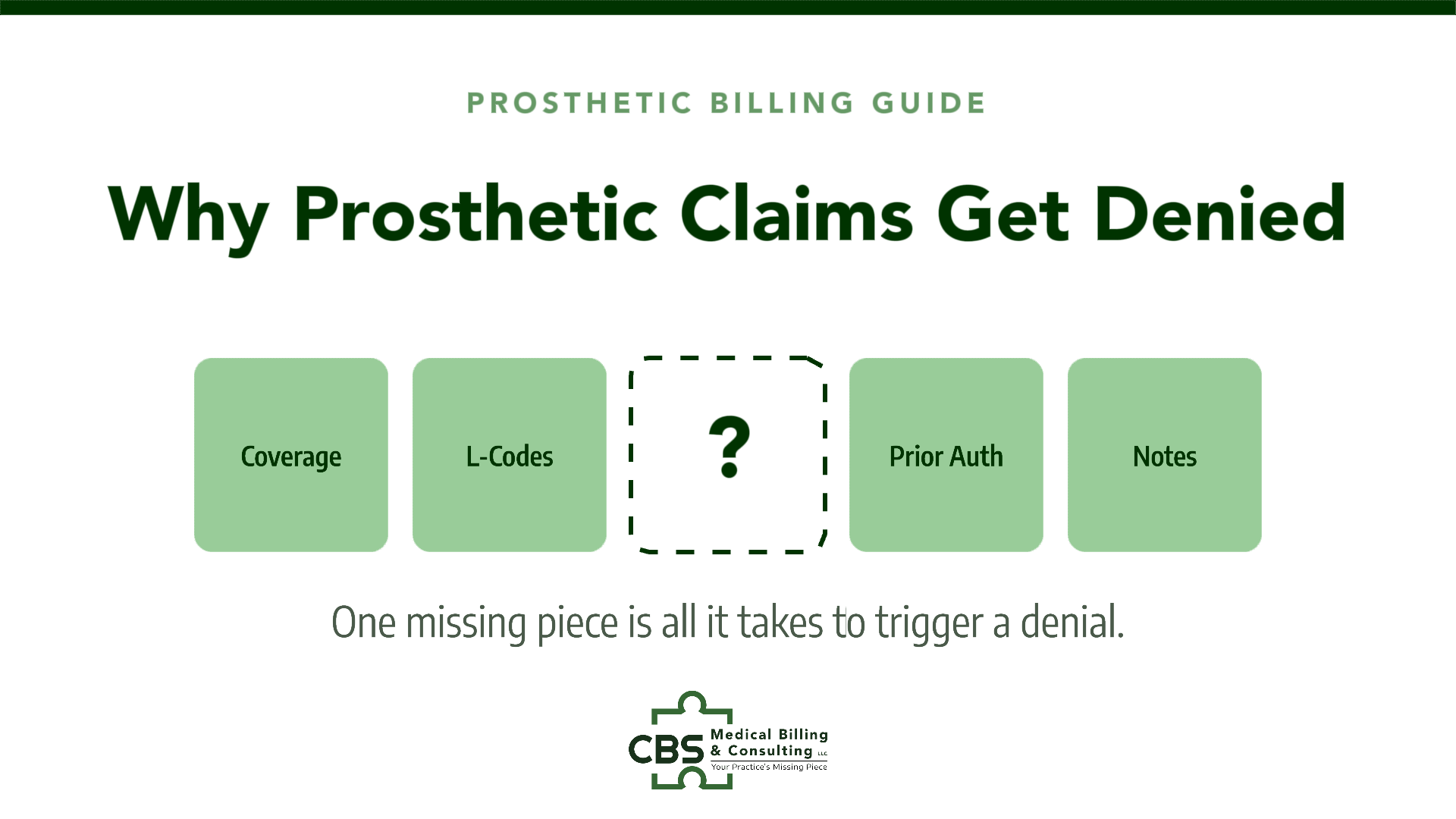
Insufficient practitioner documentation, incorrect L-codes, prior authorization issues, and breakdowns in communication can all create problems that eventually land on the prosthetic billing team’s desk. What was likely an avoidable issue has become a denied claim that needs to be corrected, resubmitted, and followed up on far more carefully than a clean claim would have.
Strong prosthetic billing practices begin long before the claim ever reaches the payer. The better an O&P practice is at identifying and preventing problems upstream in their billing processes, the faster its reimbursement timelines will be. Faster reimbursement means steadier cashflow…and what practice owner doesn’t want that?
CBS specializes in O&P billing – in 15 years, we’ve helped recover more than $750 million for our partners – so in this blog, we’re going to break down the common causes of prosthetic billing problems and what your practice can do to prevent them.
Incomplete Documentation
A clean claim in prosthetic billing is only as strong as its supporting documentation. The patient’s record needs to clearly establish what device is being provided, why it’s medically necessary, and why the specific components and L-codes are being billed.
The claim tells only part of the prosthetic billing story. Documentation provides mission critical context. For example, If the practitioner recommends a specific component or technology, the patient’s medical record must clearly support why it’s appropriate for their functional needs. Not all prosthetic devices are made equal. A myoelectric device is typically going to cost more than a body-powered prosthesis, and insurance payers aren’t typically eager to spend more than they have to. With the right documentation, however, it’s hard for them to ignore or argue with a clinical team’s decisions for patient care.
Unfortunately, prosthetic billing departments often inherit these problems after the patient has already walked out the door with the device long ago. At this point, a biller can identify what’s missing in the claim, but they can’t go back in time and recreate the clinical encounter. This means correcting the billing problem will require considerably more work before the claim can be successfully resubmitted.
So, strong clinical documentation begets better prosthetic billing. While most doctors and practitioners aren’t exactly known for their clean handwriting and elucidating notes…it’s an imperative part of the prosthetic billing process. Creating documentation workflows and providing frequent reminders, dare we say coaching, about best practices will aid a practice’s pursuit of cleaner claims!
Coding Errors
Even with sufficient documentation, the claim needs to accurately translate the patient care into medical codes. In prosthetic billing, HCPCS Level II codes – commonly called L-codes for prosthetic and orthotic services – communicate to the pater exactly what device, components, and services are being billed for. Incorrect codes, missing modifiers, or other seemingly minor details are a good way to stop an otherwise perfect claim dead in its tracks.
Consistency is especially important. The L-codes, modifiers, units, practitioner documentation, and ultimately the claim itself should all tell the same story. A good prosthetic billing process includes reviewing those pieces together before submission rather than waiting for the payer to identify a discrepancy. Accurate coding doesn’t guarantee that every prosthetic claim will be paid, but it removes many avoidable reasons for a denial. The fewer corrections a claim requires after submission, the cleaner the claim – and the faster the practice can get paid.
We won’t dive into the depths of HCPCS codes, L codes, and modifiers here…if you feel lost in the alphabet soup, you can check out our blog “What are medical codes”.
Prior Authorization
Many of the most frustrating prosthetic billing problems are also the most preventable. A perfectly documented and accurately coded claim can still be denied if the patient’s coverage simply wasn’t properly verified, or if the required prior authorizations (or pre-auths) for their particular/service wasn’t secured before the device was provided.
Understanding the patient’s insurance requirements before a practice begins helping them is essential for sustainable success in prosthetic billing. Eligibility should be verified, required authorizations identified, and payer-specific coverage policies reviewed before moving too far into the process. Authorization timing matters, too. An approval that expires before the device is delivered – or an authorization that doesn’t match the services ultimately provided – can create problems even when the practice did everything else correctly.
And if there are multiple insurers involved in the claim…yikes. Things can get even more complicated. Primary and secondary coverage need to be coordinated correctly, and each payer may have different requirements for documentation, authorization, coding, and medical necessity. What worked for one patient’s plan won’t necessarily work for the next.
In O&P, prior authorization is particularly important. Medicare has a list of specific pre-auth requirements for certain DMEPOS items, and the list is seemingly always growing. Just this year, a few items were added to the list…you can learn all about that in our article about “prior authorization for DMEPOS in 2026”.
The essential takeaway is this: many claim denials are set in motion before the billing team ever receives the claim. A strong billing process is of paramount importance, because then theres a dedicated workflow where the team must take the time to verify eligibility, understand payer requirements, and secure authorizations before the device is provided. This is an extra investment of time upfront, but it saves considerably when compared to correcting, appealing, and tracking denied claims that could’ve been prevented.
Follow Up
The first three problems we’ve discussed are about preventing prosthetic claim denials before they happen. But even the best O&P billing process won’t produce a 100% clean claim rate. Some claims will inevitably be denied – and when they are, the revenue recovery clock starts ticking.
Payers have appeal windows and timely filing limits, which means a denied claim can’t simply sit in a queue until someone has time to deal with it. The denial needs to be reviewed, the reason identified, missing information gathered, and the appropriate correction or appeal submitted within the payer’s required timeframe. A perfectly recoverable claim can become lost revenue simply because nobody followed up on it soon enough.
Denied claims quietly turn into aging Accounts Receivable all the time. One denial sits for 30 days. Then 60. Then 90. As new claims continue coming in, older denials can fall further down the priority list, becoming increasingly difficult to resolve and collect. Before long, what started as a handful of individual claim problems has become a much larger A/R problem for the practice.
Ownership and accountability are the foundation fixes to this prosthetic billing problem. We love to ask: “do you have a dedicated team member who is responsible for following up on denied claims?” Typically, we get crickets on this one.
While we prioritize building processes to keep claims clean, it’s also important to have a system for recovering denied claims. Who is responsible for it, why it was denied, what action needs to be taken, when that action occurred, and when the claim needs to be checked again are all important questions to document. “We’ll circle back” isn’t much of a denial management strategy. Every denied claim deserves an owner, a next step, and a documented path toward resolution.
Example Of A Preventable Prosthetic Billing Problem
Imagine this:
A young man is severely injured in a car accident. He’s rushed to the hospital and undergoes an emergency above elbow amputation. After recovering, he’s referred to an O&P practice, where he’s fitted with a new, state-of-the-art device and sent home. Generally speaking, everyone on the care team feels pretty good about helping their patient receive fast and effective treatment so he can begin rebuilding his life. A good day’s work.
The claim itself is coded correctly, but the supporting practitioner notes don’t adequately establish the medical necessity of the device.
When the billing team receives the denied claim, they can’t believe it. To everyone involved in patient care, the medical necessity feels obvious. This young man needs technology that can help him return to work, regain independence, and enjoy life as close to how he did before the accident as possible.
But the payer, who has never met the patient and is only experiencing the situation through paperwork… and they fail to find documentation that explicitly states why a myoelectric prosthesis was needed instead of a body-powered prosthesis.
The problem isn’t in the care provided, nor in the coding. It’s the documentation that tells the payer the complete story which the care team understood already.
This is exactly why prosthetic billing can’t be separated from the rest of the patient journey. When documentation, coding, authorization, and billing work together in harmony, practices have a much better chance of getting the claim paid correctly the first time.
Looking Beyond Billing
So far, we’ve focused on what O&P practices can do to prevent prosthetic billing problems. But sometimes the problem isn’t the documentation, coding, authorization, or billing process.
Sometimes, the problem is the coverage itself.
For many people with limb loss or limb difference, having one prosthetic device doesn’t necessarily provide everything they need to live an active, independent life. The prosthesis someone relies on for everyday mobility may not be appropriate for running, exercising, working, showering, or participating in other activities that are important to their health and quality of life. Unfortunately, insurance coverage has historically created significant barriers to accessing these additional, activity-specific devices.
So Every BODY Can Move is trying to change that.
The nationwide initiative is pursuing legislation state by state to expand insurance coverage for medically necessary prosthetic and orthotic care used for physical activity and activities of daily living. CBS proudly supports this effort because we believe patients should have access to the devices they need to move, work, exercise, and participate fully in their lives.
For prosthetists, expanded access also represents an exciting evolution in patient care. Instead of asking, “Which single device can we get covered?” the conversation can increasingly become, “Which devices will allow this patient to live the life they want to live?”
As coverage evolves, however, the fundamentals we’ve discussed throughout this blog become even more important. New coverage opportunities will still require strong documentation, accurate L-coding, appropriate authorization, and clean claims. Expanding what insurance will cover is a major step forward; making sure patients can actually access those benefits will require O&P practices to navigate the changing reimbursement landscape effectively.
We’ve been supporting this movement for a while now – if you’d like to learn more check out their website or see this blog we wrote about them two years ago.
Conclusion
If there’s one takeaway from this blog, it’s that strong prosthetic billing starts long before a claim ever reaches the payer.
The most successful O&P practices don’t simply get good at responding to denials – they build processes designed to prevent them. Strong documentation supports medical necessity. Accurate coding ensures the claim reflects the care provided. Eligibility verification and prior authorization catch coverage problems before they become denials. And when a claim does come back unpaid, consistent follow-up keeps it from quietly aging into Accounts Receivable.
Put it all together and the benefits extend far beyond a cleaner billing department. Fewer denials mean faster reimbursement, healthier cash flow, lower A/R, and less staff time spent correcting problems that could have been prevented in the first place.
Most importantly, better billing means less time spent on administrative work and more bandwidth for patient care. We’ve written more about how better O&P billing can improve patient care if you’d like to explore that connection further.
CBS Medical Billing & Consulting has specialized in O&P billing for 15 years. Each of our team members, especially our founder Erin Cammarata, has experience that goes back even further than that! If your practice is dealing with recurring prosthetic claim denials, growing Accounts Receivable, or inconsistent reimbursement timelines, we can take a closer look at your billing process, identify where problems are occurring, and help strengthen your revenue cycle from documentation through reimbursement.
Schedule a free consultation and let’s talk about how CBS can help your practice reduce denials, get paid faster, and spend more time focused on your patients.